
Transition Song
Experiencing my mother's last hours scrambles the meaning of so many things, and clarifies the only one that matters.

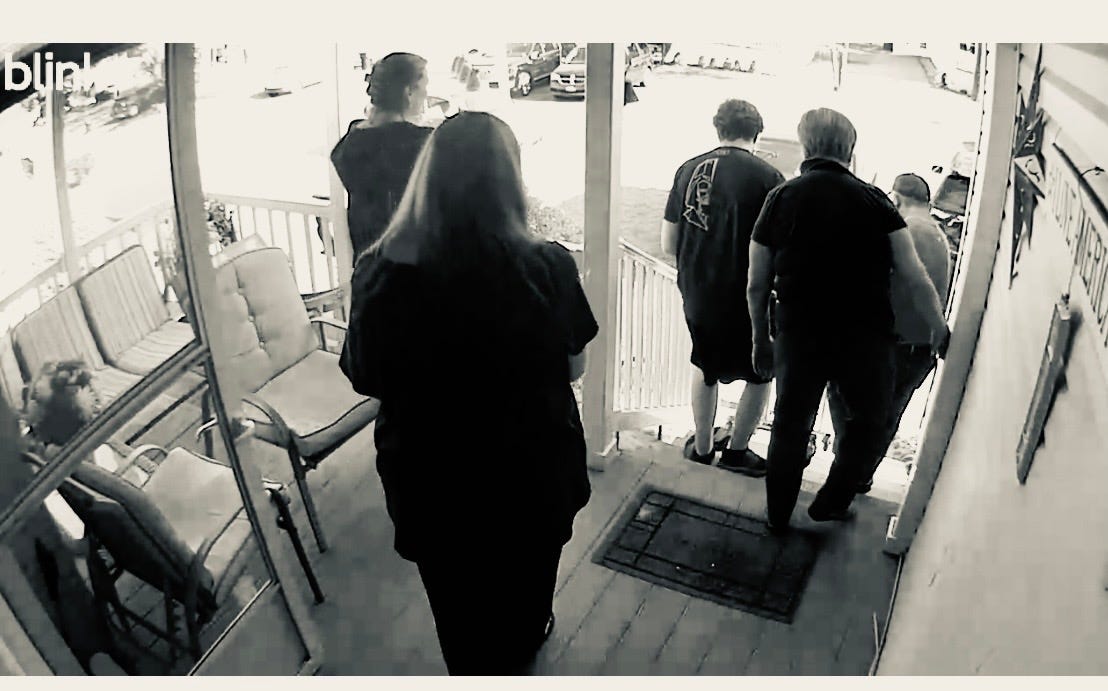
A video clip from the Blink camera installed at my parents’ house shows my mother’s body being brought out the front door in a body bag. I keep watching it on my phone, over and over; I don’t know why. It doesn’t make me cry.
Why doesn’t it make me cry?
It takes 1 minute and 6 seconds for her body to take its final trip down the front steps that had become too treacherous for her to navigate in recent months. My brother-in-law Hank and nephew Zayvius hold one end of the gurney and carefully guide it down, step by step, while my younger sister, Lisa, and I trail them out the front door and onto the covered porch to keep our eyes on the still form inside the zipped-up brown bag—what’s left of the woman who gave us life.
On the video clip, you can hear one of us quietly sobbing, but with our backs to the camera, it’s impossible to tell for sure if it’s me or her.
Doesn’t matter, really. Tears came like yawns during those sacred days, contagiously moving from one to another to another as we bridged life and death, ushering Mom lovingly out of this world to whatever comes next. Odd to say this, maybe, but it was a highlight of my life, a rare privilege that was heartbreaking and, at times, hilarious. As life is, even at the very end.
Experiencing a death happening, right in front of you over the course of many hours, frays the edges of the fabric of time. Time bent to the will of an unknowable force that we would all eventually submit to, and it left me with an altered perception of some basics I thought I’d figured out long ago: What is a mother? What is a family? What is a life?
Everything is different now.
As a hospice volunteer, I’d seen plenty of patients “in transition,” as they say. I was thinking about a few of them on the six-hour trip to Mom’s bedside after my sister used those words in her text the day before. “Hospice nurse says Mom is in transition now. They estimate she has days to a week.”
Days to a week. I ran through what I could expect to see when I got there, or soon after: her jaw slack, mouth open, breaths shallow. The purplish-blue creeping up her feet and legs as circulation drops. Her likely ability to hear but not speak. I prepped myself for everything related to her body and nothing related to my heart, since I had no idea what it might do.
I’d been up there a few weeks before, had spent 10 days with my parents just after Mom entered hospice care at home. Quiet, idle hours stroking her skin and praying over her, spoon-feeding her applesauce with crushed pills that she could no longer swallow whole.
She didn’t really know me for much of that time, but when I’d say, “My name is Robyn,” a smile would cross her face. “Robyn,” she’d repeat. “I have one of those.”
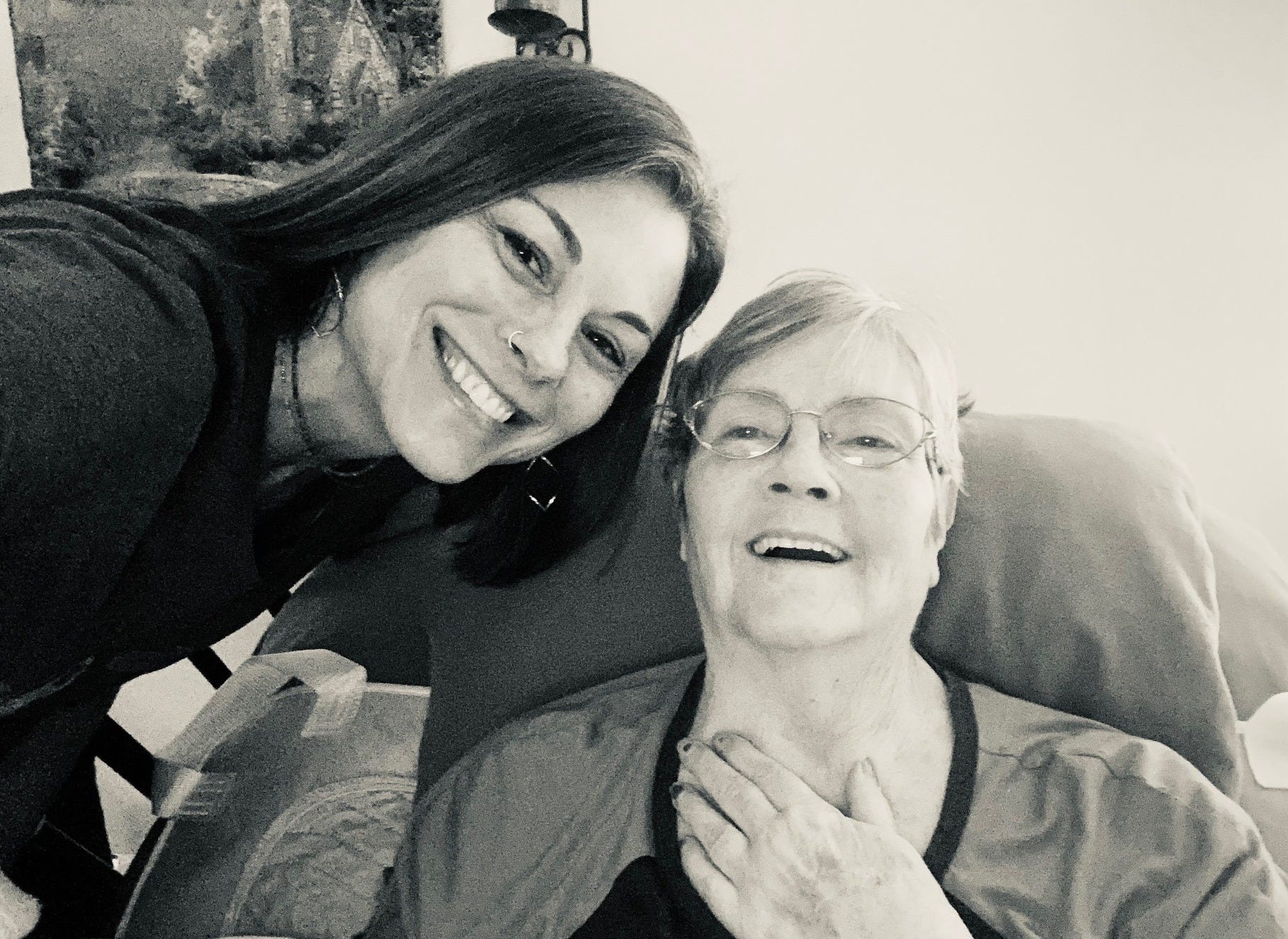
The morning I approached her bed to say goodbye, I wasn’t sure if she’d respond. “Mom?” At first, she didn’t stir. “Mom? ... Pat?” At the sound of her name, her eyes opened.
“It’s Robyn,” I smiled. “I have to go.”
She sighed, then closed her eyes. “OK,” she whispered.
Her voice held a hint of resignation, and the daughter in me loved that she seemed sad. I leaned close to her ear and inhaled her skin’s familiar scent. “You have been a great mom.”
“I tried.” Her voice was weak and her eyes remained closed, but my heart swelled at this bona fide conversation, her last gift to me.
“You were great,” I insisted, brushing aside all the ways we’d hurt each other and fallen short.
She sputtered something indecipherable, trying to give voice to every perceived failure her heart had held onto. “No.” I cut her off. “Mom. Look at me.”
She fell silent and turned her face toward mine, her eyes fluttering open.
“You did great, Mom.” We stared into each other’s eyes for several seconds. I tried to memorize her hazel eye color, and the feeling blooming in my chest from being held by her gaze.
“I love you,” I said.
“Luh you,” she replied, her eyes closing again.
It was a pretty perfect goodbye, all things considered, one that left me at peace in case I didn’t make it back to her bedside before the end.
But I did. Three weeks later I returned for one last vigil with both sisters and our dad, plus Hank, Zayvius, my nieces Ziva and Cora, our sweet Aunt Dee, and three of Mom’s dedicated caregivers—Katie, Jess, and Alivia (Jess’s 14-year-old dynamo of a daughter, who has become a best friend and caretaker to Dad). It occurred to me long afterward that besides me and my sisters, all the older adults in the room—five of them, plus our own mom—had already lost their mothers. Maybe that’s why the time was filled with so much tenderness. They mothered us daughters while we mothered our mom. Motherhood turned inside out and multiplied.
What is a mother, anyway?
We’re born from one, but life delivers many more in different forms, not all of them women—or even people. I have been mothered by more wooded trails than I can count. I’ve been mothered by friends met online. By a YouTube yoga instructor. By my sisters, in my darkest moments. And for a string of sacred hours in the middle of May this year, by everyone who witnessed my mother dying.
Which she did twice, exactly 12 hours apart.
For those unfamiliar with the active dying phase of life, breathing gets very shallow, with pauses between breaths that can extend an absurdly long time. These false alarms—when the person appears to have taken their last breath, only to shock everyone in the room with another inhale—are as wild as calling them “false alarms,” in that the false alarm is “continuing to live.”
It’s very trippy, this End Game with one player and many spectators, all rooting with love for the player to ... cross the finish line. Mom kept us guessing, crying, and laughing for days. Her breathing patterns changed drastically. Symptoms of death appeared and disappeared. I lost count of how many times we were sure “this is it,” all rushing to surround her, hold her hands and kiss her forehead while welling with tears and hugging one another, praying, telling her it was OK to go ... only to watch her eventually inhale, again. We’d stare wide-eyed at one another, tears dripping down cheeks now scrunched from laughter. Then slowly, anticlimactically, we’d trickle back to our seats, or into the kitchen to get a snack. False alarm.
We joked that she enjoyed the attention, particularly since the first day of this deathbed vigil happened to be her 82nd birthday. That morning, her daily nurse, Jess, looked at all the signs, took all the vitals, and said “I think this is it.” So we gathered around her hospital bed and sang to her, one last “Happy Birthday” serenade.
There seemed to be poetry in finishing her life on the anniversary of the day she was born. I found myself hoping it would be true—not because I didn’t want her to live, but because I knew her life here was finished. The quality of it had diminished to nothing. She was breathing, not living.
What is a life, anyway?
Mom lost hers in increments over the last couple years as her history and identity disintegrated from her mind. She lost her autonomy and her mobility. She lost her ability to travel, to pay her bills, to cook, to plan. Eventually, she lost her capability to clean and dress herself, to swallow pills, to use a straw.
While she was losing everything, we were losing her. She stopped calling me. She stopped hugging me. She stopped knowing me. I mourned those losses so thoroughly that I’d nearly convinced myself she was essentially already gone. But in the final hours of her life, I became acutely aware of what I still had with her here: The scent of her skin. The ability to hold her hand. The presence of her body in the room, and in the world. The luxury of knowing I could talk to her, and she might smile at me.
For the entirety of her birthday, she hung on. We took turns giving her an hourly dose of medicine and shifting her position in the bed, to avoid sores. With so many of us there, it should have been easy to sleep in shifts, but nobody wanted to leave for long. I think none of us wanted to miss the end. I didn’t want to miss the end. I asked myself why many times—she was in a coma, nonresponsive, and I’d already gotten my “goodbye.” Why did it matter if I happened to be at her bedside, or in the next room napping, when she took her last breath? The answer was always the same: I want to be near her while I can be near her.
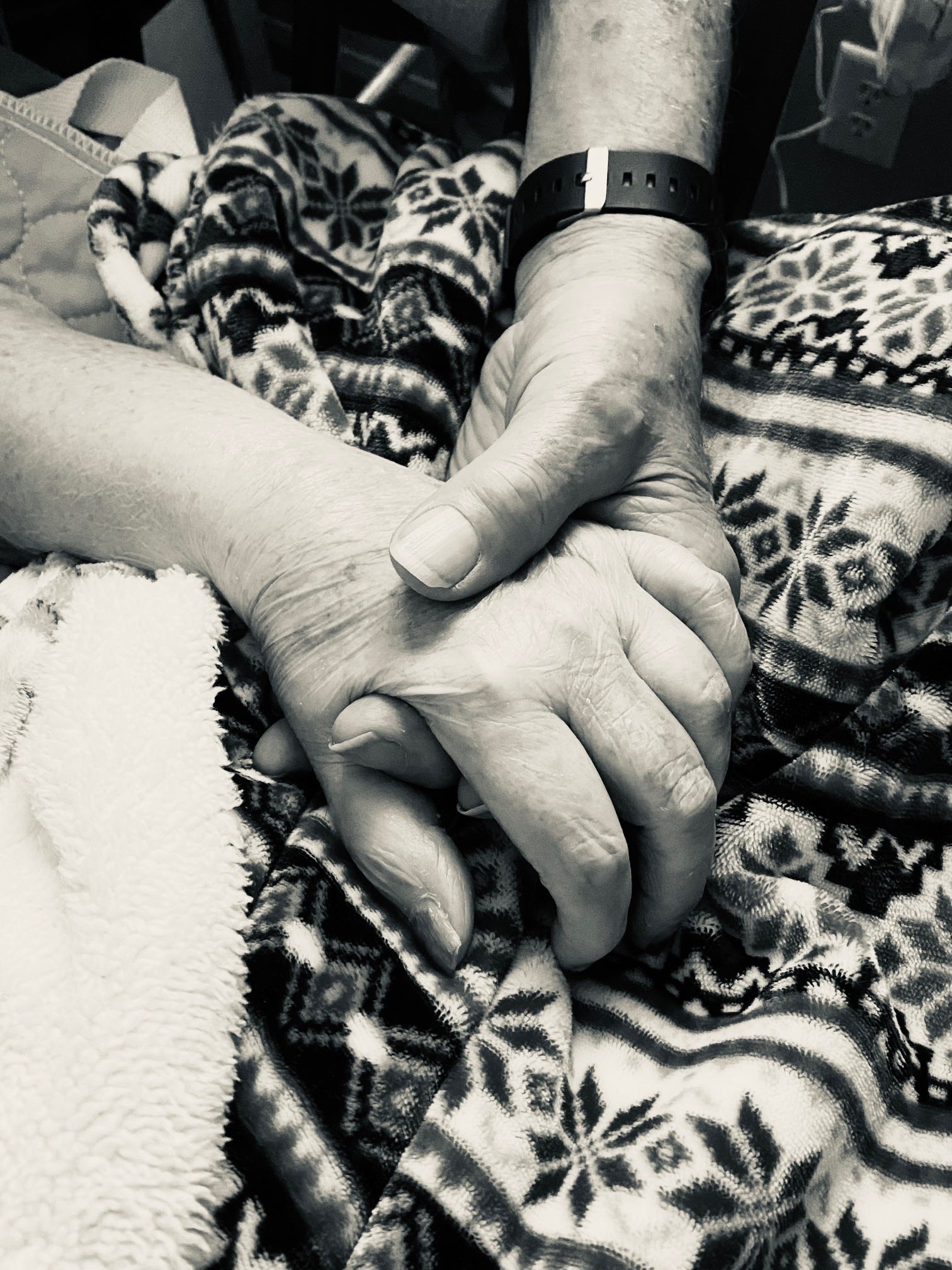
The active dying phase changes a person’s appearance. As the hours stretched on, Mom looked less and less like herself. Her facial expressions disappeared, her skin color faded, her chest caved inward. As I recognized her less, I saw her body more for the autonomous miracle it is. The heart continuing to beat, the lungs inflating, synapses firing inside her brain for 82 years without a break. 29,930 days. 718,320 hours. I found myself overwhelmed with gratefulness for those two lungs, for that very particular heart.
And I realized how much I unconsciously give us—the name and the face—credit for the way our bodies function. As if we’re all willing our brains to send the signals that keep us alive. When you watch the body of a person whose identity has all but dissolved continue to pump oxygen and blood through its system without any seeming direction from that body’s owner, you really start to wonder.
What is a person, anyway?
Is it the sum of organs and bones and skin we give a name? Is it a divine spark inside that body that melds physical with metaphysical? Is it an accumulated history, a distinct laugh, a way of being that’s very “Pat Rydzy”? She was as complicated as all of us are, layers of trauma and trials baked together with more stubbornness and resilience than I’ve come across in any other human being.
Was it stubbornness or resilience keeping her alive now? Or was it something else?
Three hours after her birthday ended, my sisters and Katie were keeping watch over Mom while Ziva and I napped. Others had drifted back to their houses and a nearby hotel, to sleep. At 3:16 a.m., Mom stopped breathing, and they frantically woke Ziva and me up. I scrambled out to the living room where our mother lay motionless in the bed; it was a different kind of stillness this time. She looked ... empty, absent of some essence she’d had before, even all the other times she’d stopped breathing. Something was gone from her, and it wasn’t just the air in her lungs. She was gray with death.
I think Kielynn checked for a heartbeat. Lisa called Hank and texted Jess, to tell them it was over. We’d need to call hospice, and they’d call the funeral home. We recited the 23rd Psalm over her body; Kielynn and Ziva whispered a Jewish prayer for the dying. We stared in silence at the shell of the woman who’d brought us into the world, a little bit in shock that the moment we absolutely knew was coming was actually here. We wondered if we should wake Dad, call Aunt Dee …
And then, minutes after her life ended, her mouth opened wide and her head lifted off the pillow as she gasped aloud and I swear to God a soul sucked itself back into her body. We all witnessed it. It was such a strange sight and sound that I had a sudden fear that maybe a nearby spirit had seen an opening and taken it, slamming itself into an empty vessel before anyone could stop it. That’s how distinct it appeared, this re-entering. Re-animating.
Whatever it was, she was back. Mom was not done living yet.
By the time Hank, Zayvius, Cora, Jess, and Alivia arrived a few minutes later, Mom was breathing normally again. We laughed nervously, apologizing for waking them. Our eyes were still searching, trying to explain, not really comprehending what we’d observed. They believed us without question; they’d all seen her defy every odd so far.
Eventually, some left again to sleep, returning a few hours later. The morning of May 18th came; people toasted bagels and made coffee, gave Mom her meds. I checked my email, and Cora came by before work. Someone gave Mom her meds. Kielynn disappeared for a nap, Lisa took a shower. Someone gave Mom her meds.
I started half-wondering if she was ever actually going to die. Waves of impatience fueled by sleep deprivation, followed by waves of love and guilt and grief.
Someone gave Mom her meds. Someone whispered something into her ear, a message for only the two of them to hear. Someone kissed her forehead and held her hand for an hour. Someone made a fresh cup of coffee. Someone took Dad out for a walk. Someone scrolled Facebook. Someone gave Mom her meds.
What is a family, anyway?
We became a family, not in name or in blood but in this very holy experience. All of us watched her chest rise and fall for hours on end and with such intensity we found ourselves holding our own breaths while waiting for her to inhale. All of us told stories, cracked jokes, cried a little, hugged whoever was nearby. All of us worried about Dad, about how the Alzheimer’s kept him from comprehending hour to hour, minute to minute, what was really happening in this room. He wanted to know Who was that in the bed? When would he be going home? Was someone going to bring lunch? Why isn’t anyone getting Pat up?
Someone made him a sandwich. Someone gave Mom her meds.
We took turns sitting on the stool positioned beside Mom’s bed. At 3:16 p.m., the person sitting in that stool was my brother Hank, who had cared for Mom as his own mother for the last several years. That minute of that day he watched her chest peacefully fall, and not rise. Quietly, he alerted those nearby, who alerted those in other rooms, and we gathered around her bed for the last time.
We stared at her still chest and her empty face for many long moments before bringing Dad over. Is this really it? It was. A shift in energy in the room told us so. We cleared the way for him to stand closest to her face. He took her hand, bent down and kissed her. “I love you dearly, Pat.” She was already gone, but she already knew. We loved her dearly, and we had done our best to give her a pain-free, dignified end.
By the time the hospice nurse came to mark the official time of death, it was just after 4 p.m. But we know her body’s journey ended at 3:16 p.m., exactly 12 hours after the first time.
I like the symmetry in that.
I also like thinking about how Pat Rydzy became a mother on March 16, 1970, when my sister Kielynn was born. 3:16. Motherhood changes a person. A life. A family. Whatever those are, anyway.
We thought we wouldn’t want to see her body zipped up in a bag and removed from the house. Too sad, too graphic. So my sisters, Ziva, and I shuttled ourselves into the back bedroom to avoid watching the funeral workers do their job. But seconds later I was drawn back to the living room by an overwhelming sense of protectiveness and love. I needed to be near her for as long as I could be near her. I could never again hug my mother, but I could hold her with my gaze until she was out of sight.
And so we did.
Sometimes now I imagine her as a swirl of love in the wind, the breeze that carries dandelion seed to fertile ground. Other times I think of her as a version of her human self that is clear-eyed and able-bodied again, seeing us for the first time in a while for who we are and how we loved her.
How we love her still, and always.
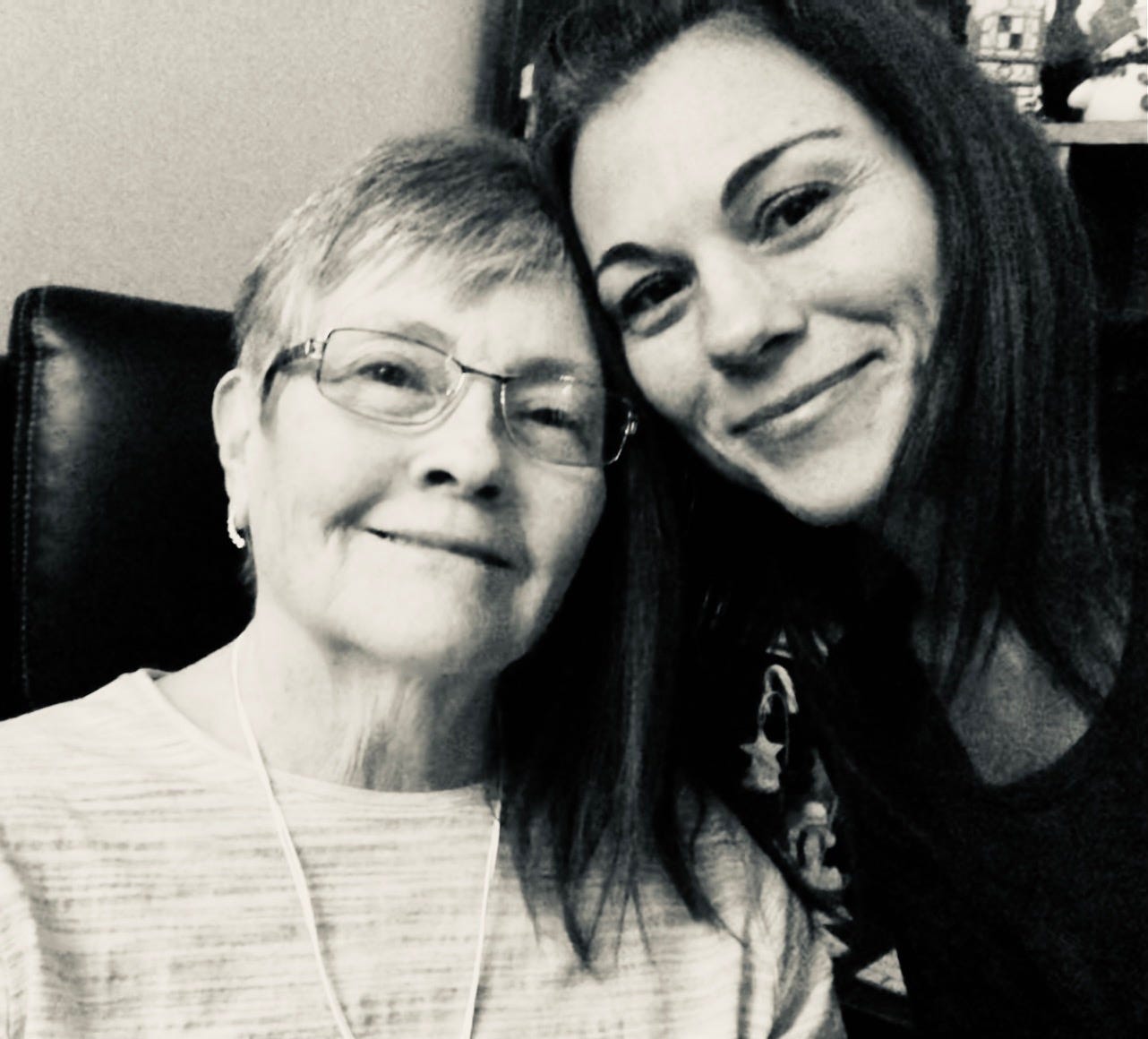
John 3:16: For God so loved the world that he gave his only son, that whoever believes in him shall not perish, but have eternal life.
Damn Robyn. It was so hard to read this incredibly written essay. You may not feel like it, but you are a rock. Watching you handle the most difficult life stuff this past year with such strength and grace has been a huge learning experience for me. Forever in awe of you and your writing, beautiful friend. Your mom is so proud ❤️❤️❤️